Tuesday, July 30, 2013

Trading with Moving Average

A moving average indicator is used to help us forecast future prices. By looking at the slope of the moving average, you can better determine the potential direction of market prices. 

The two major types of moving averages:
  1. Simple
  2. Exponential
Simple moving average (SMA) is the simplest type of moving average. Basically, a simple moving average is calculated by adding up the last "X" period's closing prices and then dividing that number by X. Here is an example of how moving averages smooth out the price action.

Simple Moving Averages


On chart above, we have plotted three different SMAs on the 1-hour chart of USD/CHF. As you can see, the longer the SMA period is, the more it lags behind the price.


Notice how the 62 SMA is farther away from the current price than the 30 and 5 SMAs.
This is because the 62 SMA adds up the closing prices of the last 62 periods and divides it by 62. The longer period you use for the SMA, the slower it is to react to the price movement.

The SMAs in this chart show you the overall sentiment of the market at this point in time. Here, we can see that the pair is trending.
Instead of just looking at the current price of the market, the moving averages give us a broader view, and we can now gauge the general direction of its future price. With the use of SMAs, we can tell whether a pair is trending up, trending down, or just ranging.

Exponential moving averages (EMA) give more weight to the most recent periods. In our example below, the EMA would put more weight on the prices of the most recent days, which would be Days 3, 4, and 5.

Let's say we plot a 5-period SMA on the daily chart of EUR/USD.


5-SMA on EUR/USD

The closing prices for the last 5 days are as follows: Day 1: 1.3172
Day 2: 1.3231
Day 3: 1.3164
Day 4: 1.3186
Day 5: 1.3293

The simple moving average would be calculated as follows:
(1.3172 + 1.3231 + 1.3164 + 1.3186 + 1.3293) / 5 = 1.3209

Well what if there was a news report on Day 2 that causes the euro to drop across the board. This causes EUR/USD to plunge and close at 1.3000. Let's see what effect this would have on the 5 period SMA.
Day 1: 1.3172
Day 2: 1.3000
Day 3: 1.3164
Day 4: 1.3186
Day 5: 1.3293

The simple moving average would be calculated as follows:
(1.3172 + 1.3000 + 1.3164 + 1.3186 + 1.3293) / 5 = 1.3163

The result of the simple moving average would be a lot lower and it would give you the notion that the price was actually going down, when in reality, Day 2 was just a one-time event caused by the poor results of an economic report.

This would mean that the spike on Day 2 would be of lesser value and wouldn't have as big an effect on the moving average as it would if we had calculated for a simple moving average.
If you think about it, this makes a lot of sense because what this does is it puts more emphasis on what traders are doing recently.

Let's take a look at the 4-hour chart of USD/JPY to highlight how an SMA and EMA would look side by side on a chart.


Exponential Moving Averages


Notice how the red line (the 30 EMA) seems to be closer price than the blue line (the 30 SMA). This means that it more accurately represents recent price action. You can probably guess why this happens

It is because the EMA places more emphasis on what has been happening lately. When trading, it is far more important to see what traders are doing NOW rather what they were doing last week or last month.

Remember, using moving averages is easy. The hard part is determining which one to use! 

That is why you should try them out and figure out which best fits your style of trading. Maybe you prefer a trend-following system. Or maybe you want use them as dynamic support and resistance.

Whatever you choose to do, make sure you read up and do some testing to see how it fits into your overall trading plan. 

For more details about Forex Trading with ICM Brokers, please click the link: www.ICMBrokers.com and feel free to access our product and services that can help you easily to trade.

Tuesday, July 23, 2013

Trading with Candlesticks

Most of the traders use candlesticks on their charts but do not fully understand the signals given by candlesticks. The learning curve on how to correctly interpret a candlestick pattern obviously begins with studying what the shapes and shadows mean, and then seeing if a trend is indicated.

Long vs Short Candlestick

Long bodies indicate strong buying or selling. The longer the body is, the more intense the buying or selling pressure. Short bodies imply very little buying or selling activity.

The Shadow
If a candlestick has a long lower shadow and short upper shadow, this means there is a buyers rejection.
  1. Sellers force price lower, but for one reason or another, 
  2. Buyers came in and drove prices back up to end the session.
Anatomy of a Japanese candlestick
If a candlestick has a long lower shadow and short upper shadow, this means there is a sellers rejection.
  1. Buyers force price higher, but for one reason or another,
  2. Sellers came in and drove prices back down to end the session.
Long Vs. Short Shadows

The upper and lower shadows on candlesticks can tell a lot about the trading session. Candlesticks with short shadows indicate that most of the trading action was confined near the open and close, while candlesticks with long shadows indicate that the price extended well past the open and close.

longshadow

Candlesticks with a long upper shadow and short lower shadow show buyers dominated during the session and pushed prices higher, but sellers later forced prices down from their highs before close. On the other hand, candlesticks with long lower shadows and short upper shadows show that sellers dominated during the session and drove prices lower, but buyers later bid prices higher by the end of the session.

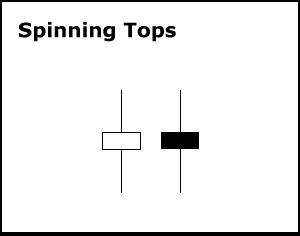
spinning topSpinning tops 
Spinning tops are candlesticks with long upper and lower shadows with small bodies. These candle sticks are known for representing indecision. The small body shows little movement from open to close and the shadows indicate that both bulls and bears were active during the session but neither could gain the upper hand. Spinning tops can signal both the top of a run and the bottom of a decline.


doji
Doji
The doji is formed when a stock’s open and close are exactly or almost equal. The length of the upper and lower shadows can be long or short, but the resulting candlestick looks like a cross or plus sign. Although a doji can help signal a reversal much like the spinning top, they should never be used alone. Any bullish or bearish signal using the doji is based on preceding price action and future confirmation.


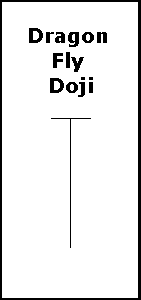
dragonfly dojiDragon Fly Doji
A dragon fly doji is made when the open, high and close are equal, but the stock’s low creates a long lower shadow, creating a candle that looks like a “T”. A dragon fly doji shows that sellers dominated trading and drove prices lower during the session, but that buyers came back and pushed prices back to the opening level and the session high. A dragon fly doji can be used to signal a potential reversal of a downtrend as well as a potential reversal of an uptrend.


gravestone doji
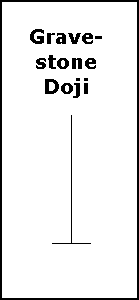
Gravestone Doji
The gravestone doji is simply an upside down dragon fly doji. The gravestone doji shows that buyers dominated trading and drove prices higher during the session, but that sellers pushed back and drove prices back to the opening level and the session low. As with the dragon fly doji, the gravestone doji only indicates a reversal based on previous price action and future confirmation. Even though the long upper shadow shows a failed rally, the intraday high shows there is buying pressure, so bearish or bullish confirmation is required.


Understanding the psychology behind the candlestick is far more important than the pattern itself because in reality, when you are trading live at the right hand edge of the chart, the patterns are not so easy to see.

For more details about Forex Trading with ICM Brokers, please click the link: www.ICMBrokers.com and feel free to access our product and services that can help you easily to trade.

Wednesday, July 3, 2013

How to Identify Support and Resistance Levels?


Support and Resistance represent key junctures where the forces of supply and demand meet. In the financial markets, prices are driven by excessive supply (down) and demand (up). Supply is synonymous with bearish, bears and selling. Demand is synonymous with bullish, bulls and buying. 

As demand increases, prices advance and as supply increases, prices decline. When supply and demand are equal, prices move sideways as bulls and bears slug it out for control.

Trend Lines
In their most basic form, an uptrend line is drawn along the bottom of easily identifiable support areas (valleys). In a downtrend, the trend line is drawn along the top of easily identifiable resistance areas (peaks).

There are three types of trends:
  1. Uptrend (higher lows)
  2. Downtrend (lower highs)
  3. Sideways trends (ranging)
Channels
To create an up (ascending) channel, simply draw a parallel line at the same angle as an uptrend line and then move that line to position where it touches the most recent peak.
To create a down (descending) channel, simple draw a parallel line at the same angle as the downtrend line and then move that line to a position where it touches the most recent valley.
  1. Ascending channel (higher highs and higher lows)
  2. Descending channel (lower highers and lower lows)
  3. Horizontal channel (ranging)
What is Support? 
A price level on a chart where historically the trade has had difficulty falling below. The price level acts as a floor and prevents the price of the trade from falling any further.


A level of Support is always found BELOW prices.

There are two ways the trade will test this level of support:

  1. Either the trade will fall to this level and then "bounce" off of it and begin to rise again or...
  2. The trade will fall to this level, break through it, and continue dropping until it finds another level of support, a resting spot so to speak.
Below is an example of how support works. The trade found support around $40. It bounced around $40 for some time and then when it finally broke the $40 threshold, it continued dropping until it found its next level of support around $29.


The more times a trade falls to the level of support and bounces off it, the more significant (stronger) the price level becomes.

What is Resistance? 
The price level at which selling is thought to be strong enough to prevent the price from rising further.
The logic dictates that as the price advances towards resistance, sellers become more inclined to sell and buyers become less inclined to buy. By the time the price reaches the resistance level, it is believed that supply will overcome demand and prevent the price from rising above resistance.


Resistance does not always hold and a break above resistance signals that the bulls have won out over the bears. A break above resistance shows a new willingness to buy and/or a lack of incentive to sell. 

Resistance breaks and new highs indicate buyers have increased their expectations and are willing to buy at even higher prices. In addition, sellers could not be coerced into selling until prices rose above resistance or above the previous high. Once resistance is broken, another resistance level will have to be established at a higher level.


Two methods in trading support and resistance levels 

The bounce we want to tilt the odds in our favor and find some sort of confirmation that the support or resistance will hold. Instead of simply buying or selling right off the bat, wait for it to bounce first before entering. By doing this, you avoid those moments where price moves so fast that it slices through support and resistance levels like a knife slicing through warm butter.


The break there is the aggressive way and there is the conservative way. In the aggressive way, you simply buy or sell whenever the price passes through a support or resistance zone with ease. In the conservative way, you wait for price to make a "pullback" to the broken support or resistance level and enter after price bounces.

Conclusion
In conclusion, you must study how a trade behaves at key support and resistance levels and take note of market trend. This is a good time to look for or take the opposite side of the primary trend. Remember, climactic volume eats up a large amount of buyers and sellers and tends to produce sharp snap backs in either direction as buyers have put in major support and sellers will have put in major resistance going forward.


For more details about Forex Trading with ICM Brokers, please click the link: www.ICMBrokers.com and feel free to access our product and services that can help you easily to trade.

Wednesday, June 19, 2013

Forex Trading Market Orders

For some traders you may hear the terms trailing stop loss and stop loss order and wonder exactly what these are and how a stop loss can enhance a trading strategy. 


Let’s start with the basics, defining a stop loss order and other types of orders.

-Order Types-

Market Order  is an order to buy or sell at the best available price.

For Example:  The bid price for EUR/USD is currently at 1.2140 and the ask price is at 1.2142. If you wanted to buy EUR/USD at market, then it would be sold to you at the ask price of 1.2142. You would click buy and your trading platform would instantly execute a buy order at that exact price.

Limit Entry Order is an order placed to either buy below the market or sell above the market at a certain price.
 
For Example: The  EUR/USD is currently trading at 1.2050. You want to go short if the price reaches 1.2070. You can either sit in front of your monitor and wait for it to hit 1.2070 (at which point you would click a sell market order), or you can set a sell limit order at 1.2070 (then you could walk away from your computer to attend your ballroom dancing class).

If the price goes up to 1.2070, your trading platform will automatically execute a sell order at the best available price.You use this type of entry order when you believe price will reverse upon hitting the price you specified.
  
Stop-Entry Order is an order placed to buy above the market or sell below the market at a certain price.

For Example: The GBP/USD is currently trading at 1.5050 and is heading upward. You believe that price will continue in this direction if it hits 1.5060. You can do one of the following to play this belief: sit in front of your computer and buy at market when it hits 1.5060 OR set a stop-entry order at 1.5060. You use stop-entry orders when you feel that price will move in one direction.

Stop-Loss Order is a type of order linked to a trade for the purpose of preventing additional losses if price goes against you. REMEMBER THIS TYPE OF ORDER. A stop-loss order remains in effect until the position is liquidated or you cancel the stop-loss order.

For Example: As you went long (buy) EUR/USD at 1.2230. To limit your maximum loss, you set a stop-loss order at 1.2200. This means if you were wrong and EUR/USD drops to 1.2200 instead of moving up, your trading platform would automatically execute a sell order at 1.2200 the best available price and close out your position for a 30-pip loss.

Stop-losses are extremely useful if you do not want to sit in front of your monitor all day worried that you will lose all your money. 

Trailing Stop is a type of stop-loss order attached to a trade that moves as price fluctuates.

For Example: The USD/JPY at 90.80, with a trailing stop of 20 pips. This means that originally, your stop loss is at 91.00. If price goes down and hits 90.50, your trailing stop would move down to 90.70.
Just remember though, that your stop will STAY at this price. It will not widen if price goes against you. 

Going back to the example, with a trailing stop of 20 pips, if USD/JPY hits 90.50, then your stop would move to 90.70. However, if price were to suddenly move up to 90.60, your stop would remain at 90.70.
Your trade will remain open as long as price does not move against you by 20 pips. Once price hits your trailing stop, a stop-loss order will be triggered and your position will be closed.

-Other Terms-


Good 'Till Cancelled (GTC) an order remains active in the market until you decide to cancel it. Your broker will not cancel the order at any time. Therefore it's your responsibility to remember that you have the order scheduled.

Good for the Day (GFD) an order remains active in the market until the end of the trading day. Because foreign exchange is a 24-hour market, this usually means 5:00 pm EST since that is the time U.S. markets close, but we'd recommend you double check with your broker.

One-Cancels-the-Other (OCO) an order is a mixture of two entry and/or stop-loss orders. Two orders with price and duration variables are placed above and below the current price. When one of the orders is executed the other order is canceled.

For Example: The price of EUR/USD is 1.2040. You want to either buy at 1.2095 over the resistance level in anticipation of a breakout or initiate a selling position if the price falls below 1.1985. The understanding is that if 1.2095 is reached, your buy order will be triggered and the 1.1985 sell order will be automatically canceled.

One-Triggers-the-Other
An OTO is the opposite of the OCO, as it only puts on orders when the parent order is triggered. You set an OTO order when you want to set profit taking and stop loss levels ahead of time, even before you get in a trade

For Example:  The USD/CHF is currently trading at 1.2000. You believe that once it hits 1.2100, it will reverse and head downwards but only up to 1.1900. The problem is that you will be gone for an entire week and there is no available internet.

In order to catch the move while you are away, you set a sell limit at 1.2000 and at the same time, place a related buy limit at 1.1900, and just in case, place a stop-loss at 1.2100. As an OTO, both the buy limit and the stop-loss orders will only be placed if your initial sell order at 1.2000 gets triggered.


Conclusions to this topic, The basic order types (market, limit entry, stop-entry, stop loss, and trailing stop) are usually all that most traders ever need. Stick with the basic stuff first. Make sure you fully understand and are comfortable with your broker's order entry system before executing a trade.

Also, always check with your broker for specific order information and to see if any rollover fees will be applied if a position is held longer than one day. Keeping your ordering rules simple is the best strategy.

For more details about Forex Trading with ICM Brokers, please click the link: www.ICMBrokers.com and feel free to access our product and services that can help you easily to trade.


Thursday, June 13, 2013

Leverage in Forex Trading

What Is Leverage? 
Leverage involves borrowing a certain amount of the money needed to invest in something. In the case of Forex, that money is usually borrowed from a broker. 
Forex trading does offer high leverage in the sense that for an initial margin requirement, a trader can build up and control a huge amount of money.

Investors use leverage to profit from the fluctuations in exchange rates between two different countries. The leverage that is achievable in the Forex market is one of the highest that investors can obtain. Leverage is a loan that is provided to an investor by the broker that is handling his or her Forex account. When an investor decides to invest in the Forex market, he or she must first open up a margin account with a broker. Usually, the amount of leverage provided is either 50:1, 100:1 or 200:1, depending on the broker and the size of the position the investor is trading. Standard trading is done on 100,000 units of currency, so for a trade of this size, the leverage provided is usually 50:1 or 100:1. Leverage of 200:1 is usually used for positions of $50,000 or less.

Here is a sample chart of how much account balance changes if prices moves depending on your leverage.
Leverage
% Change in Currency Pair
% Change in Account
100:1
1%
100%
50:1
1%
50%
33:1
1%
33%
20:1
1%
20%
10:1
1%
10%
5:1
1%
5%
3:1
1%
3%
1:1
1%
1%

Example Situations:

Day 1. A mini account with $500 which trades $10K mini lots and only requires .5% margin.

You buy 2 mini lots of EUR/USD. Your true leverage is 40:1 ($20,000 / $500). You place a 30-pip stop loss and it gets triggered. Your loss is $60 ($1/pip x 2 lots).

You have just lost 12% of your account ($60 loss / $500 account). Your account balance is now $440. 

Trade #
Starting Account Balance
# Lots of Used
Stop Loss (pips)
Trade Result
Ending Account Balance
1
$500
2
30
-$60
$440

Day 2. You decide to double up and you buy 4 mini lots of EUR/USD. Your true leverage is about 90:1 ($40,000 / $440). You set your usual 30-pip stop loss and your trade loses. Your loss is $120 ($1/pip x 4 lots).

You have just lost 27% of your account ($120 loss/ $440 account). Your account balance is now $320.
Trade #
Starting Account Balance
# Lots of Used
Stop Loss (pips)
Trade Result
Ending Account Balance
2
$440
4
30
-$120
$320
 
Day 3. You believe the tide will turn so you trade again. You buy 2 mini lots of EUR/USD. Your true leverage is about 63:1. You set your usual 30 pip stop loss and lose once again! Your loss is $60 ($1/pip x 2 lots).
You have just lost almost 19% of your account ($60 loss / $320 account). Your account balance is now $260.
Trade #
Starting Account Balance
# Lots of Used
Stop Loss (pips)
Trade Result
Ending Account Balance
3
$320
2
30
-$60
$260
 
Day 4. You are getting frustrated. You try to think what you are doing wrong. You think your setting your stops too tight.
The next day, you buy 3 mini lots of EUR/USD. Your true leverage is 115:1 ($30,000 / $260). You loosen your stop loss to 50 pips. The trade starts going against you and it looks like you are about to get stopped out yet again! But what happens next is even worse! You get a margin call!
Since you opened 3 lots with a $260 account, your Used Margin was $150 so your Usable Margin was a measly $110. The trade went against you 37 pips and because you had 3 lots opened, you get a margin call. Your position has been liquidated at market price.


Trade #
Starting Account Balance
# Lots of Used
Stop Loss (pips)
Trade Result
Ending Account Balance
4
$260
3
50
Margin Call
$150

The only money you have left in your account is $150, the Used Margin that was returned to you after the margin call.

The Summary of your trading account has gone from $500 to $150. A 70% loss! It would not be very long until you lose the rest.
Trade # Starting Account Balance # Lots of Used Stop Loss (pips) Trade Result Ending Account Balance
1 $500 2 30 -$60 $440
2 $440 4 30 -$120 $320
3 $320 2 30 -$60 $260
4 $260 3 50 Margin Call $150

A four trade losing streaks is not uncommon. Experienced traders have similar or even longer streaks. 

To avoid such a catastrophe, Some Forex traders use low leverage and most use their leverage at 5:1 but rarely go that high and stay around 3:1. Other experienced traders succeed because they use proper capitalization which allows to realize losses that are very small and allows you to trade another day.


To know more about our ICM Brokers Contract Specifications please click the link: ICMBrokers Contract Specifications